
Freed From a Belarus Prison, a Nobel Peace Laureate Experiences ‘Oxygen Intoxication’
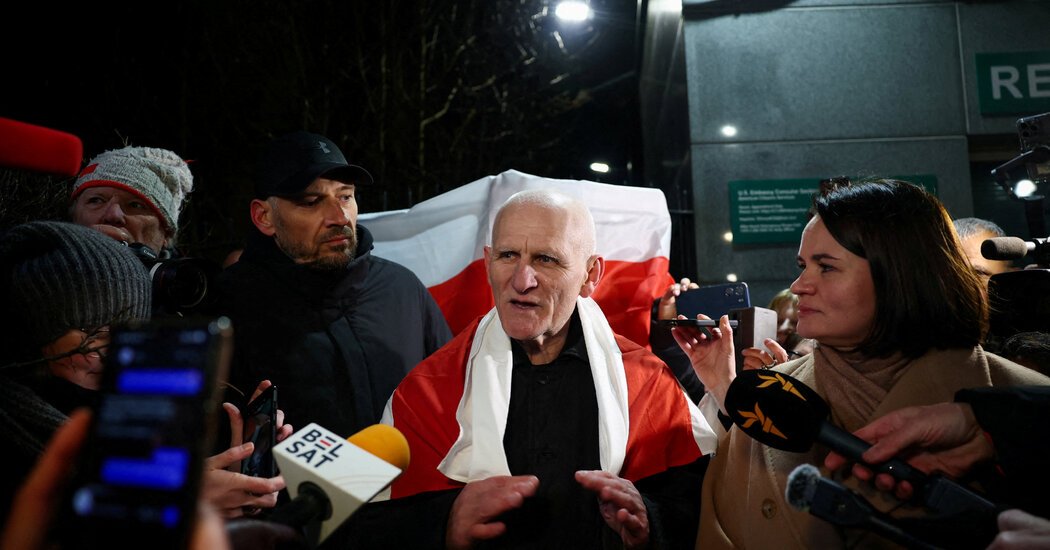
Just a few days ago, Ales Bialiatski, a Nobel Peace Prize laureate, was blindfolded, placed into a vehicle, and transported from a notorious prison in his homeland of Belarus to the border with Lithuania. It was then that his blindfold was removed. Mr. Bialiatski had been serving a 10-year sentence on charges of “smuggling” and “financing public disorder,” accusations that are largely viewed as politically driven. Suddenly, he found himself free. “It feels like leaping out of a space that offers no air,” the seasoned human rights advocate said in an interview on Friday in Vilnius, six days post-release after having completed nearly half of his sentence. “You experience such oxygen intoxication that your head begins to swirl instantly.”The organization that Mr. Bialiatski established, Viasna, monitors the status of political prisoners in Belarus, which has a population of 9.5 million. Following his release last Saturday, along with 122 other inmates, it found that 1,103 individuals were still imprisoned.
Mr. Bialiatski’s liberation occurred following a meeting between an envoy for President Trump and Belarus’s leader, Aleksandr G. Lukashenko, who announced that the United States would ease sanctions on potash fertilizer, a key economic driver for Belarus. Also freed were Maria Kolesnikova and Viktor Babariko, two prominent opposition leaders in Belarus. Mr. Bialiatski, now 63, conveyed deep appreciation for gaining his freedom but remarked that he felt as though he had been “trafficked” as part of a deal—released only when there was some economic benefit for Belarus. “They merely loaded me like a sack of flour and shifted me across the border,” he stated. “We are essentially commodities to be sold.”
While incarcerated, Mr. Bialiatski worked in a carpentry workshop at Penal Colony No. 9, located in the eastern Belarusian city of Gorki, fulfilling manual labor duties for eight hours daily. He was tasked with lifting and relocating wood remnants from the workshop, which, according to Viasna’s reports, manufactures pallets for the Russian military, among other items. “Considering my age, it was physically demanding for me,” he shared. “By the end of each workday, my tongue felt like it was on my shoulder” due to exhaustion, he noted. For more than two years, he bore a swollen leg from a vein condition that made it difficult for him to fit his foot into his boots. It took over a year for the penal colony to arrange surgery for his leg, and he now has a series of medical appointments lined up as a result of his release. Because 50% of his meager wages was deducted by the prison for his housing, and an additional 25% was taken to pay a fine of about $82,000 imposed during his sentencing, he earned between $10 and $15 each month for his labor. Nevertheless, Mr. Bialiatski expressed that he preferred the workshop to periods spent in solitary confinement.
He spent six months confined in a solitary cell, which he described as a “prison within a prison.” Although the cell was warm, the window was broken and covered with polyethylene that was growing mold, giving the room the feel of an airless cellar. During those six months, he was only permitted one 20-minute walk each day. Separately, he was repeatedly sent to a different punitive cell for minor infractions that he claimed were often fabricated by the prison staff, such as being inadequately shaven or walking alone. That cell was unbearably cold, compelling him to exercise to maintain warmth. “I could drift off for 15 minutes, but then I’d awaken because I was shuddering,” he said, estimating the temperature to be around 40 degrees Fahrenheit. “I had to move about to keep warm.” Each day at 5 a.m., the bed was secured to the wall, and he was prohibited from lying down during daylight hours, forcing him to sit on a frigid iron bench. Although he believes that his Nobel recognition likely spared him from direct physical assaults, he frequently faced restrictions on letters, family visits, and care packages containing vital medicines. He was unable to see his wife, Natalia Pinchuk, for over three years, and during the last year of his imprisonment, he mentioned that prison censorship allowed him to receive only one letter from her, while she never got his correspondence.
He stated that inmates were coerced into attending mandatory film screenings that were typically focused on Russian imperialist narratives and the Russian Orthodox Church. Mr. Bialiatski addressed the audience from Vilnius, which is just across the border from Belarus and has become a refuge for tens of thousands of its exiles. He spoke at a cultural center that serves as a hub for Belarusian language, culture, and identity; all of which faced suppression during the Soviet era and are increasingly viewed by Belarusian authorities as indicators of opposition sentiment. Mr. Bialiatski, a soft-spoken man with shimmering eyes, began his activism journey in the late 1980s when the Soviet Union was disintegrating and began allowing more political dissent.
He created a literary society to fight against decades of Soviet policies aimed at erasing the Belarusian language. He was actively involved in honoring the victims of Stalin-era repressions, similar to the Russian organization Memorial, with which he shared the Nobel Peace Prize in 2022, alongside the Ukrainian Center for Civil Liberties. Mr. Lukashenko has been in power since 1994. Two years after he assumed office, constitutional amendments were enacted to dissolve Parliament, which also granted Mr. Lukashenko the authority to appoint and dismiss judges at all levels. The government severely cracked down on dissenters, and Mr. Bialiatski established Viasna to aid those who were jailed and their families. The organization has since developed into one that also documents instances of torture and mistreatment of political prisoners. In 2011, he was arrested and given a lengthy prison sentence for alleged tax evasion, which he denied. He was released early as part of a national amnesty.
Around that time, Mr. Lukashenko attempted to enhance economic ties with Western nations, and by early 2020, there was only a single political prisoner remaining. That situation shifted dramatically in August of that year when tens of thousands of Belarusians protested against what were perceived as fraudulent elections. Mr. Lukashenko and his associates brutally suppressed the democratic demonstrations, leading to sanctions from Western nations. Those sanctions were intensified in 2022 after Mr. Lukashenko permitted Russian forces to invade Ukraine from Belarusian soil. The restrictions particularly targeted key aspects of Belarus’s economy, such as potash, a significant export. Mr. Bialiatski noted that the sanctions were a “strong lever” as they severely harmed Belarus’s economy. While he expressed appreciation for Washington’s involvement, he stated that the European Union, whose 27 member states have maintained limited engagement with Minsk since 2022, should refrain from lifting sanctions until systemic reforms occur within Belarus.
Despite the release of numerous political prisoners over the past two years, individuals continue to be sentenced regularly. “What is the purpose of freeing some if they are detaining others?” Mr. Bialiatski questioned. He advocated for an absolute end to political repression so that individuals would not be imprisoned for their beliefs, and called for the annulment of “draconian” laws that categorize journalists and human rights advocates like him as “extremists.” For the time being, Mr. Bialiatski stated that he wished to concentrate on reconnecting with his family and learning about the developments that took place during the 1,613 days he was incarcerated. He mentioned that he had been unaware of the level of international backing he received. He indicated plans to continue his work but is still in the process of outlining his future steps. Lastly, he remarked that the European Union ought to keep viewing Mr. Lukashenko as illegitimate and maintain hope that its initiatives could foster change. He referenced that for half a century, Western nations did not officially recognize the Soviet annexation of Estonia, Latvia, and Lithuania. Nowadays, all three nations are part of the European Union and NATO, standing as some of Ukraine’s most ardent supporters against Russia. “No one can predict how long the Lukashenko regime will persist,” he concluded. “It could collapse tomorrow, or continue for a long time.”
Published: 2025-12-21 10:01:00
source: www.nytimes.com