

The Truce Is 2 Months Old. So Why Have Hundreds of Gazans Been Killed?
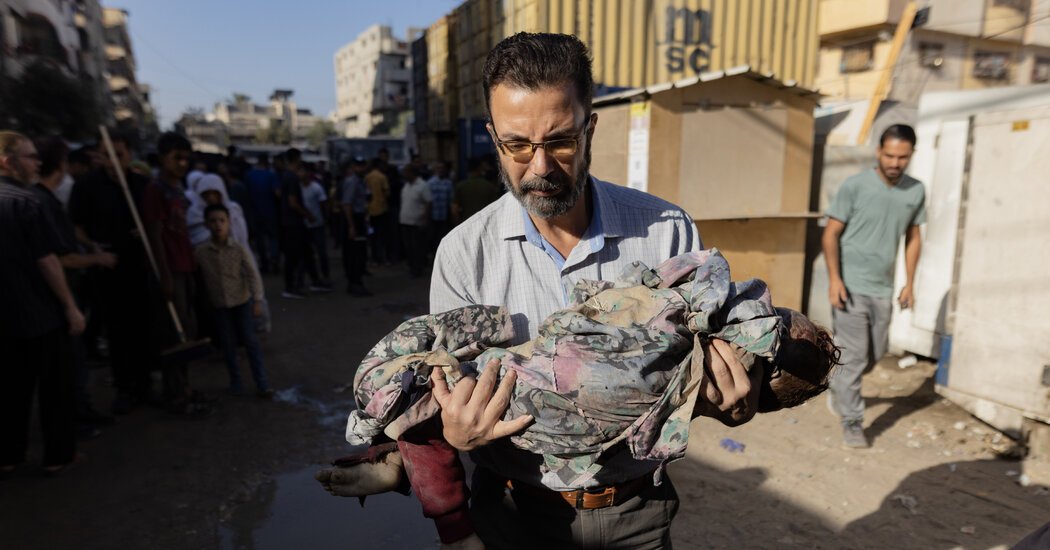
The truce in Gaza has lasted for over two months. However, the fatalities among Palestinians have not ceased for more than a brief period. Death can result from crossing the Yellow Line, the vaguely marked border separating eastern Gaza, where the Israeli forces have embedded themselves, from the western part, where Hamas is attempting to regain control over Gaza’s population of more than two million. Numerous times since the cease-fire commenced on October 10, Palestinians have been killed for crossing eastward, whether they were aware of it or not. Palestinians assert that the ongoing violence indicates that Israel disregards the cease-fire and shows indifference, at best, towards the lives of Gazan civilians. Meanwhile, the Israeli military claims it has only opened fire as a reaction to cease-fire infractions, stating that its engagement rules allow targeting only those perceived as threats. Death can also come from familial ties to the wrong individuals, as was the case for much of the Abu Dalal family in Nuseirat. When Israel targeted two cousins on October 29 — claiming they were local militant commanders — missile strikes overnight obliterated their homes. One of the cousins was killed, along with 18 other extended family members, including two toddlers aged 3. For Maysaa al-Attar, 30, a pharmacy student, death occurred because she was in an unfortunate location. She was shot in the abdomen while sleeping in her parents’ tent in northwest Gaza early on November 14. Just three weeks prior, they had put up the tent on the site of their destroyed family home. For Ali al-Hashash, 32, death came around 8 a.m. on November 6 while he was searching for firewood east of the Yellow Line to provide for his pregnant wife, who was due any day, and their 4-year-old son. There was no cooking gas available in the Bureij refugee camp where they resided, according to his father, Hasan al-Hashash. This is a peril many in Gaza are willing to take as winter approaches. On December 18, Mr. al-Hashash’s companion, Saeed al-Awawda, 66, was shot while gathering wood in the same region, Mr. al-Hashash reported. “He lost his hand,” he stated. “I keep thinking, ‘I wish my son had only lost his hand, too, not his life.’” Lt. Col. Nadav Shoshani, a spokesperson for the Israeli military, mentioned that the army’s protocols are intended to prevent civilian casualties. When unarmed Palestinians cross over to the Israeli side of the Yellow Line, he indicated, soldiers are instructed to caution them to turn back, and as a last resort, to stop them by firing at their lower legs. He noted that Hamas militants in civilian attire, sometimes armed covertly, were probing the Yellow Line, rendering almost anyone approaching Israeli positions a potential threat. “In most cases, the violations are committed by Hamas,” Colonel Shoshani stated. “And in the majority of cases where it’s not Hamas, we are able to warn people, and they turn back.” The Israeli military could not comment on the incident involving Ms. al-Attar, stating it was unaware of it. Palestinian authorities claim that 406 individuals have been slain since the cease-fire, including 157 children. This number is far less than the devastation experienced during the previous two years of warfare, which began with the Hamas-led assault on October 7, 2023, resulting in 1,200 deaths and triggering an Israeli incursion into Gaza, where local health officials report 70,000 fatalities — averaging hundreds per week. Nevertheless, the rising death toll underscores the tenuousness of the truce, with a poorly defined border, hostile adversaries in close proximity, and Palestinian militants occasionally emerging from tunnels on the Israeli-controlled side to open fire on Israeli soldiers. The disparity in casualties on each side also reflects the ongoing practice of the Israeli military’s stringent wartime responses, which involve retaliating with significant force and permitting strikes on militants even when there is a high risk of civilian casualties.
A Family Outing With No Return On October 17, a week into the cease-fire, a dozen members of the Shaban and Abu Shaban families got into a van in Gaza City for a trip. Believing in the relative safety afforded by the cease-fire, they left the crowded tent encampment where they were staying to visit their two homes in Zeitoun, a largely damaged neighborhood to the southeast. One of those homes was dangerously close to the unmarked Yellow Line. Fourteen-year-old Othman Shaban was part of the excursion. He recalled that the family arrived at one house to assess what remained. Then, he remembered, “My father suggested, ‘Let’s check on our other house.’ We were enjoying ourselves as we departed.” He mentioned that he and his father had previously collected firewood in the vicinity by foot several times, leading them to believe it was safe. Othman indicated that their van encountered rubble obstructing the road. “I exited the vehicle and moved the stones off the path,” he recounted. This action spared him. As his father advanced the van to pick him up again, he stated, “I suddenly heard an explosion.” A relative who stayed behind, Mohammed Abu Shaban, expressed his belief that Othman’s father may have unknowingly driven toward the Yellow Line. The Israeli military later marked it with yellow-painted concrete blocks. “Gaza is so ravaged that it’s easy to get lost,” Mr. Abu Shaban remarked. Othman sustained neck and leg injuries. Everyone else in the van lost their lives: his parents, three of his siblings — a sister, Nisma, 16, and brothers Anas, 12, and Karam, 10 — along with Mr. Abu Shaban’s sister, her husband, their daughter Jumana, 9, and their sons Naser, 12, Ibrahim, 6, and Muhammad, 4. The Israeli military issued a statement saying that its forces had fired warning shots at “a suspicious vehicle” that had crossed the unmarked line, but claimed the vehicle continued advancing towards them “in a manner that posed an imminent threat” and therefore, “the troops opened fire to eliminate the threat.” Colonel Shoshani added that the distance from the Yellow Line to Israeli territory is often “a two-minute drive.” However, Othman stated that there were no warning shots, only the explosion that took his family’s lives. Othman’s account of the location of the incident — on Salah al-Din Road, a significant Gaza route, hundreds of yards west of the Yellow Line — contradicts the Israeli military’s perspective. According to his version, the van was not situated close enough to the Israeli territory to be deemed threatening. The military claims there was no attack at the location Othman described. Civil Defense rescuers waited nearly a full day for Israeli approval to retrieve the bodies from the charred vehicle, Mr. Abu Shaban noted. They found only nine — or “eight and a half,” he specified, to be morbidly exact.
Two Targeted, 18 Others Killed In spite of the truce, militants in Gaza have intermittently attacked Israeli soldiers. Each occurrence has elicited Israel’s overwhelming response, targeting expansive areas far removed from the locations of the attacks. On October 28, a sniper fatally shot an Israeli soldier in Rafah — marking the third Israeli soldier killed since the cease-fire and, to date, the final one in the conflict. That same night, Israel retaliated, resulting in at least 100 deaths across Gaza. It was midnight in Nuseirat, approximately 16 miles north of Rafah, when missiles struck one of two homes belonging to the extended Abu Dalal family. The following day, the Israeli military claimed it had targeted 25 militants in Gaza, including Yahya Abu Dalal and Nazmi Abu Dalal, whom it identified as leaders in the militant group Islamic Jihad. The military made no mention of civilian casualties. Amr Al-Sabakhi, 20, was at his home across the street when he claimed two missiles hit the residence of his aunt Hala, the wife of Yahya Abu Dalal, 50. He rushed outside to assist and discovered his cousin Bayan, 15, lifeless, his body torn in two. Yahya and Hala were both deceased. Bayan’s three brothers also lost their lives, including the 11-year-old Mostafa, as did other members of their extensive family, including twin 3-year-old boys. Another neighbor, Muhammad Qasem, 41, mentioned that his mother sustained a deep scalp injury from the explosion. “I always anticipated that house would be struck,” he remarked, acknowledging the likelihood that Yahya Abu Dalal could be a target for Israel. However, he added, “I thought at least there would be a warning, so the neighbors wouldn’t be harmed.” He stated that there was none. Colonel Shoshani, the spokesman for the Israeli military, stated that planned airstrikes undergo a “rigorous process of approval.” While Israel warns civilians prior to attacking buildings or infrastructure, it does not issue warnings when targeting specific enemy individuals, to prevent them from evading arrest — “and there’s no army in the world that does,” he argued. He did not clarify whether Israel was unaware of the numerous civilians present or deemed the targets justified to risk civilian lives. Additional members of the Abu Dalal family rushed in to assist following the airstrike, including Nizar Abu Dalal, 48, who lived nearby. He returned to his own home a couple of hours later, according to his wife, Iman Abu Dalal. Their daughter, Dareen, 23, noted that she and her mother debated whether to leave but concluded they had nowhere safer to flee. Shortly after 3:30 a.m., Iman Abu Dalal recounted, “I heard the whistling sound of a missile,” then felt herself being thrown violently before losing consciousness. Dareen, two of her siblings, and her young daughter, Shatha, all survived the strike. Her father Nizar was killed, along with a 24-year-old brother, Majd, who was scheduled to be married in November. Instead, his body was discovered days later, trapped beneath concrete debris. The Israeli military justified the strikes on the homes, asserting that the two targets, Yahya and Nazmi Abu Dalal, had long been involved in orchestrating and leading terrorist operations against Israel. Above Nizar’s residence, where Nazmi lived, the devastation was significantly worse. Nazmi, the target of the second airstrike, was injured but survived. Tragically, no one from his immediate family survived. His wife was killed, along with their seven children, ranging from 21-year-old Baraa to 8-year-old Zeinab. Baraa had painted her nails that afternoon, as stated by her cousin Dareen. When the results of the Tawjihi, the college-entry exam for Palestinian high school seniors, were released a few weeks later, one daughter, 18-year-old Duha, achieved a score of 96.7 percent. Abu Bakr Bashir contributed reporting.
Published: 2025-12-25 01:57:00
source: www.nytimes.com