
With Airspace Closed, a Lonely Christmas for Many Venezuelans
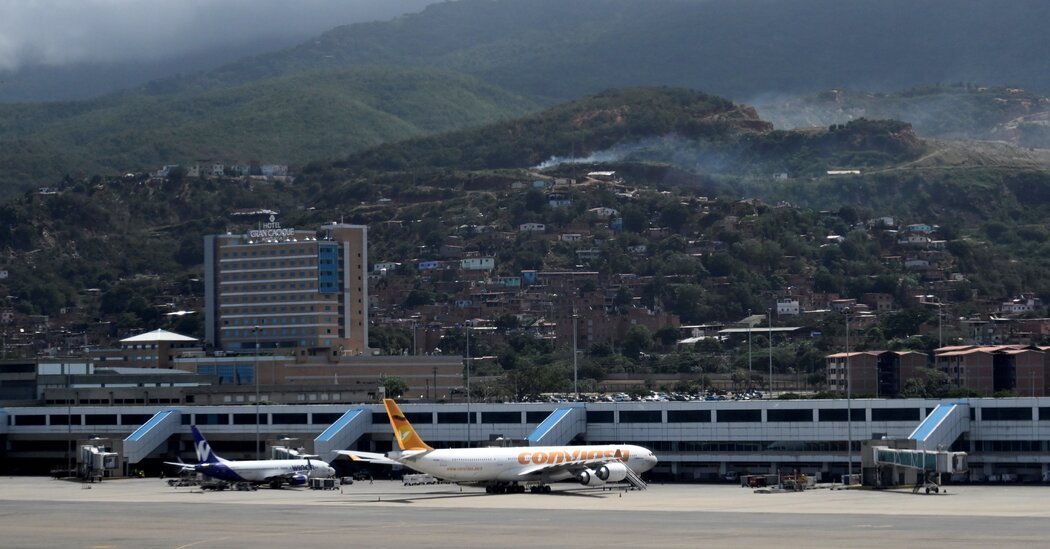
Countless Venezuelans are experiencing a holiday season stranded abroad or isolated at home, unable to be with family after President Trump announced the closure of the airspace surrounding Venezuela over three weeks ago. Most international airlines have nearly ceased operations, leaving only a few aging planes from Venezuela’s airlines to facilitate travel in and out of the country of nearly 30 million. Passengers have flocked to the few available flights, resulting in increased fares. Many members of Venezuela’s large diaspora, some of whom fled due to economic collapse, scrapped their return plans following the cancellation of their flights home. “That day, I cried a lot,” recounted Vanessa Rojas, a 37-year-old Venezuelan residing in Argentina. She had spent two years saving for tickets for herself and her young daughter, intending to return home for Christmas. The challenge of returning for the festive season has come at a particularly strained moment for Venezuelans inside and outside the nation. Many have been anxiously observing as the Trump administration has intensified its pressure on the country’s authoritarian ruler, Nicolás Maduro, whom numerous individuals blame for the economic and humanitarian crisis — exacerbated by U.S. sanctions — that has forced millions to leave over the past decade. Recently, the Trump administration has focused on Mr. Maduro, accusing him of harboring drug-trafficking organizations deemed as terrorist entities; bombing small vessels believed to be transporting illegal drugs; amassing military assets in the Caribbean; and seizing or attempting to capture oil tankers poised to transport sanctioned Venezuelan oil. The Venezuelan government condemned Mr. Trump’s airspace closure announcement on Nov. 29 as a “colonialist threat.” In a matter of days, numerous major international airlines canceled flights to Venezuela following warnings from the U.S. Federal Aviation Administration regarding “heightened military activity” and safety concerns. Subsequently, Venezuela revoked operating licenses for several foreign airlines that had suspended services. Two Venezuelans engaged in the country’s aviation sector, who requested anonymity due to their not being authorized to comment publicly, indicated that the number of air travelers arriving at Venezuela’s principal international airport, which services Caracas, had dwindled to approximately 2,000 weekly, a mere fraction of its typical volume. They noted that a few thousand additional passengers were arriving at other airports, including individuals on charter flights to Margarita Island from locations like Russia and Poland. Noemi Gómez, 34, not only faced disrupted Christmas plans but also a postponed wedding. She and her fiancé, who both work in marketing in Madrid, were set to wed in Venezuela on Dec. 20. However, their return flight, originally scheduled for Dec. 11, was canceled. Instead of celebrating their marital union and reconnecting with family in Venezuela on Christmas Eve, Ms. Gómez said the couple ended up traveling to the Dominican Republic. They expressed hopes of marking their marriage and the end of Mr. Maduro’s governance soon. She attributed the failed arrangements to Mr. Maduro, rather than Mr. Trump, stating that Venezuela’s leader was the cause of many being forced to live away from their families in the first place. “It’s because of that government, that man — they’re illegitimate and they shouldn’t be there,” Ms. Gómez stated. Mr. Maduro proclaimed victory in the 2024 presidential election, a result that election specialists broadly consider as fraudulent. In cities worldwide with notable Venezuelan communities, such as Miami, Madrid, New York, and Mexico City, the same query resonated: Who is to blame for their country’s increasing isolation? What will happen next? In Mexico City, Antonio Balassone, 35, whose first visit home in three years was canceled, expressed his desire for a government change but opposed military intervention. “I don’t want war,” he remarked. Many Venezuelans pursued convoluted paths to reach home despite the new hurdles. María Acosta, 28, traveled from Bogotá, Colombia, where she resides, to the coastal city of Riohacha, Colombia. From there, she crossed into Venezuela and shared a taxi to her hometown, Valencia. “I try to spend Christmas with those few still there,” shared Ms. Acosta, an environmental engineer, who noted that her family had become “disintegrated” and now lives in the United States, Colombia, and Spain. The looming possibility of military action had cast a shadow over the holidays even for those who successfully returned home. “You come to Venezuela and you want to savor the flavors, breathe the air and sun, hug your loved ones,” she explained. “Now I just think about how I want to return to Bogotá in peace.” While some emotional reunions occurred recently at Caracas’s airport, the international arrivals area, typically bustling with cheerful families, has been relatively subdued. Tourism has dwindled to a mere trickle on Margarita Island, according to a hotel operator who requested anonymity due to concerns about retribution from the Maduro administration. “We lost all our bookings,” he mentioned. Yet, he appeared optimistic about 2026. “For those of us in Venezuela, these setbacks have become the norm,” he explained. “We pick ourselves up, we dust ourselves off, and we keep moving forward.” Reporting was contributed by Sheyla Urdaneta, Jorge Valencia, Carlos Prieto, Patricia Sulbarán, and Alejandro Cegarra.
Published: 2025-12-25 10:02:00
source: www.nytimes.com