

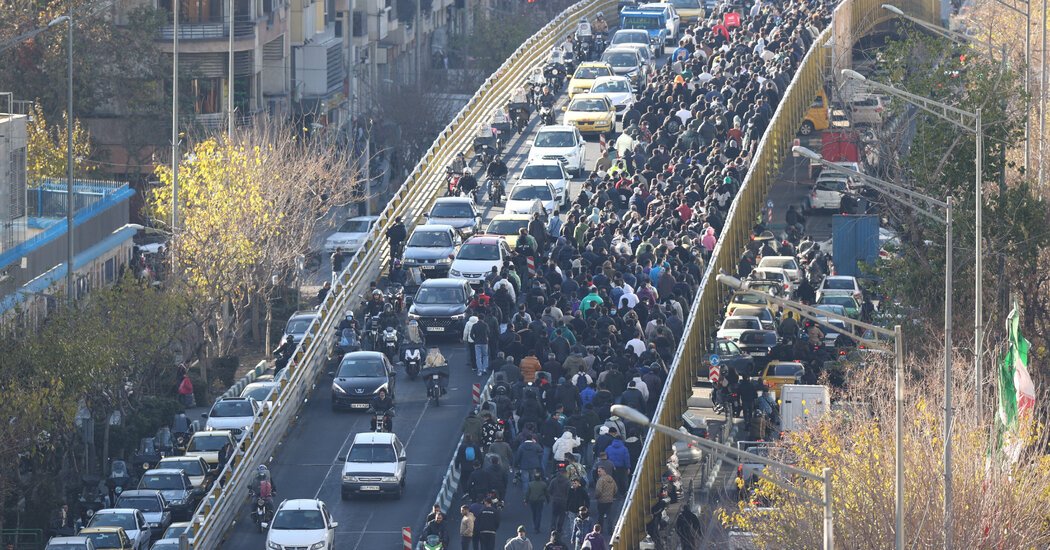
Iran’s Currency Collapse Pushes Protesters to the Streets
Demonstrators took to the streets of the capital, Tehran, and various other cities across Iran on Monday to protest soaring inflation and the devaluation of the national currency, which have thrown markets into disarray and strained family finances. The currency dropped to an all-time low against the U.S. dollar this past weekend, and the annual inflation rate climbed to 42.2 percent in December. Amidst this upheaval, the head of Iran’s central bank, Mohammad Reza Farzin, offered his resignation on Monday, pending approval from the president, local news outlets reported. Abdolnaser Hemmati, a former economy minister, is expected to take over his position. This economic instability presents a new obstacle for Iran’s authorities as they attempt to maintain governance over their population of 92 million while recovering from assaults on its nuclear sites in June by Israel and the United States, along with a campaign of “maximum pressure” from the Trump administration aimed at reaching a new accord regarding Iran’s nuclear initiatives. President Masoud Pezeshkian addressed the protests late Monday on social media. “The livelihood of the people is my daily concern,” Mr. Pezeshkian expressed in a message on X. He stated that the government has plans in place to “reform the monetary and banking system and safeguard the population’s purchasing power,” also mentioning that he has directed the interior minister to “acknowledge the legitimate demands of the protesters through discussions with their representatives.” Mr. Pezeshkian’s conciliatory tone and his prompt decision to replace the central bank leader indicate he aims to demonstrate responsiveness and a commitment to de-escalation. Iran has faced recurring waves of protests driven by economic troubles, drought, and other grievances since 2017, and it remains uncertain if the current demonstrations will increase in size or expand to more cities. Iranian security forces have previously suppressed protests with lethal force and detentions, heightening the risks for individuals who voice their concerns publicly. Footage shared online on Monday depicted security personnel using tear gas to break up some protests in Tehran and in at least two additional cities. Analysts link Iran’s worsening economic distress to multiple factors, ranging from inadequate management to policies that isolate the nation’s economy. The Trump administration’s intensified measures to restrict Iran’s oil exports to foreign nations and the conflict with Israel in June, during which the government utilized Iranian banks to manage its expenses, have also exacerbated the economic situation. The government has limited options for rapidly addressing the crisis, according to Amir Hossein Mahdavi, a political science doctoral candidate at the University of Connecticut who focuses on Iran’s economy. He noted that the government could alter its relationship with the United States for relief from sanctions, or significantly reduce government expenditures, though neither of these solutions seems probable. “Currently, the threat of prolonged high inflation and a replication of recent scenarios like those in Venezuela and Argentina is becoming increasingly significant,” Mr. Mahdavi remarked. The proposed 2026 budget illustrated the government’s quandary, reflecting a considerable decline in oil revenues and an increased dependency on tax income. On Monday, the Parliament denied the proposed budget, as reported by the semiofficial Tasnim News Agency. The Ministries of Economy and Foreign Affairs did not promptly respond to requests for comments. The currency crash has inflicted severe hardship on everyday Iranians, who have seen their salary and savings values plummet while the costs of goods and services have surged. Omid, a 42-year-old sales manager in Tehran, mentioned that his monthly income has diminished from $300 to just $200 in a span of two months, causing him anxiety. He expressed concern about his ability to afford his elderly parents’ medical expenses and feared that if his car broke down, he wouldn’t be able to repair it. “These days, even socializing with friends feels restricted, as we’re continuously calculating like human calculators whether we can manage the cost of a simple coffee,” he explained. Mariam, a 41-year-old bank employee in Tehran, shared that others perceive her as upper middle class, despite her salary now only covering two-thirds of her monthly expenditures. Both Mariam and Omid communicated via telephone and requested to only be identified by their first names to avoid retaliation from the government. Mariam noted that she seldom dines out, shuns buying red meat, and refrains from inviting people over for meals. “Things have escalated in expense to the point that over the last few days, when I had visitors, I was constantly tallying numbers to make sure I wouldn’t run out of money before the month concluded,” she stated.
Published: 2025-12-30 02:27:00
source: www.nytimes.com