
In New Year’s Speech to Russia, Putin Says Little About Ukraine War or Peace Talks With US
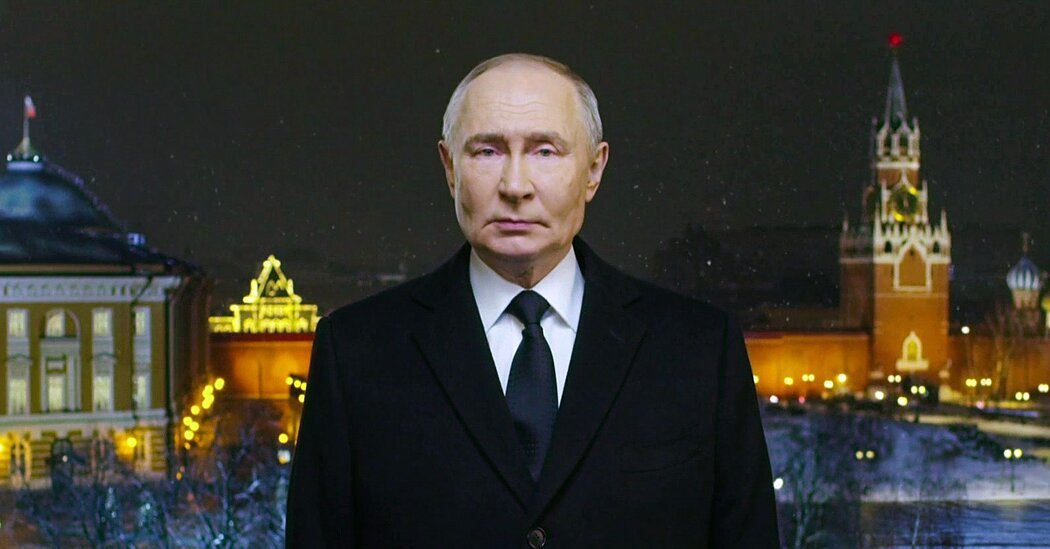
President Vladimir V. Putin of Russia allocated just over half a minute of his annual New Year’s Eve message on Wednesday to the ongoing situation in Ukraine, as exhausted Russians increasingly desire an end to the conflict. Mr. Putin, delivering a concise address with the Kremlin’s outer walls as a backdrop, told the nation’s soldiers they were undertaking the responsibility of battling for their “native land, for truth and justice.” He further noted that the Russian populace is confident that victory will be secured. The Russian leader, however, delivered a more general message, reminiscent of his speeches from the previous two years. He characterized Russia as “one large family,” resilient and unified, aspiring for a brighter future. In 2022, by contrast, Mr. Putin stood before officers in military attire and spent almost nine minutes discussing the war, criticizing what he termed a deceitful West. The war was already 10 months old at that time, and Ukraine, supported by Western allies, had successfully thwarted Russia’s aspirations for a swift victory. This year, the address lasted slightly longer than three minutes. After nearly four years of conflict, polls indicate that Russians are increasingly calling for a settlement to conclude the hostilities. Nonetheless, Mr. Putin did not address President Trump’s efforts for peace or Moscow’s initiatives to better relations with Washington.
In December, 66 percent of Russians supported peace negotiations, according to a survey conducted by Levada, an independent polling organization. This marked the highest proportion since the pollster began asking the question in 2022. Only 25 percent of respondents expressed a preference for continuing the fighting, the lowest figure recorded. Despite these sentiments, Mr. Putin has shown minimal inclination to negotiate. His greatest concession appears to be demanding that Ukraine relinquish only the remaining territory in the Donetsk region that it still occupies, instead of the entirety of the four regions that Moscow claimed to have annexed in 2022. Ukraine holds vast portions of that area. More than 50 percent of Russians surveyed by Levada expressed doubt that Washington’s attempts to mediate peace would succeed. In his address, Mr. Putin did not mention an end to the conflict.
In stark contrast, Ukraine’s President, Volodymyr Zelensky, centered his New Year’s message entirely on the war. “In just a few minutes, the new year will begin,” he stated. “And I would give anything in the world if, in this address, I could say that peace will also come in just a few minutes.” Mr. Zelensky mentioned that a draft peace plan developed with the United States is “90 percent ready.” The final 10 percent pertains to territorial issues, postwar security assurances, and oversight of a crucial nuclear facility—issues that remain unresolved and have contributed to the continuation of the war, he noted. “Those 10 percent contain, in fact, everything,” Mr. Zelensky remarked. “They will determine the fate of peace, the fate of Ukraine and Europe, and how people will live. Ten percent to save millions of lives.” After Mr. Zelensky’s meeting with Mr. Trump at Mar-a-Lago on Sunday for the latest peace negotiations, Moscow claimed it had intercepted numerous drones purportedly launched by Ukraine at one of Mr. Putin’s residences located in the Novgorod region.
Mr. Zelensky rejected the accusation as a falsehood aimed at undermining the negotiations. Alerts and posts on Telegram that night indicated drones approaching the region from the south, but did not clarify what was targeted. On Wednesday, the Russian Defense Ministry shared footage on social media, purportedly showing one of the drones, which resembles a type commonly employed by Ukrainian forces, lying partially damaged in the snow. It could not be independently verified when or where that drone was shot down. The ministry also released what it described as an interview with a local citizen who recounted hearing the sound of interceptor missiles, a claim that also could not be independently verified. Ukrainian and Western critics of the Russian government, citing a history of misleading or dubious statements by the Kremlin as it conducts an information war alongside the physical conflict, argue that Moscow’s assertions may indicate an interest in finding a pretext to withdraw from peace negotiations. The critics further contend that the Kremlin is attempting to turn Mr. Trump more against Ukraine. On Wednesday, Kaja Kallas, the European Union’s leading diplomat, labeled Russia’s claims as “a deliberate distraction.” “Moscow aims to derail real progress towards peace by Ukraine and its Western partners,” she shared on social media.
Russian officials stated that due to the claimed attack, the Kremlin would harden its position regarding making peace with Ukraine. Yuri Ushakov, Mr. Putin’s foreign policy advisor, mentioned that “Russia’s position on a number of previously agreed upon agreements and emerging solutions will be reevaluated.” In Russia, the annual presidential address—broadcast five minutes before midnight—forms the highlight of New Year’s Eve, the nation’s most significant secular celebration. Initially delivered by Soviet leaders, this address has transformed in modern Russia into a significant event reflecting presidential policy and the national sentiment. Through these addresses, Russian leaders have historically aimed to strike a more personal chord, taking on the role of “father of the nation” to instill a sense of stability and hope. In 1999, President Boris N. Yeltsin began a new chapter by using the address to announce his resignation and appoint Mr. Putin, then the prime minister, as his successor. For Mr. Putin, New Year’s Eve speeches have reflected the transformation of his presidency. In the early 2000s, he concentrated on democratic reforms and stability. As the Russian economy grew in later years, he emphasized wealth and prosperity. In recent times, as tensions with the West intensified, his speeches have displayed an increasingly militarized and confrontational perspective. Riley Mellen and Aric Toler contributed reporting.
Published: 2025-12-31 23:02:00
source: www.nytimes.com