
European Allies Confirm Significant Security Arrangements for Ukraine
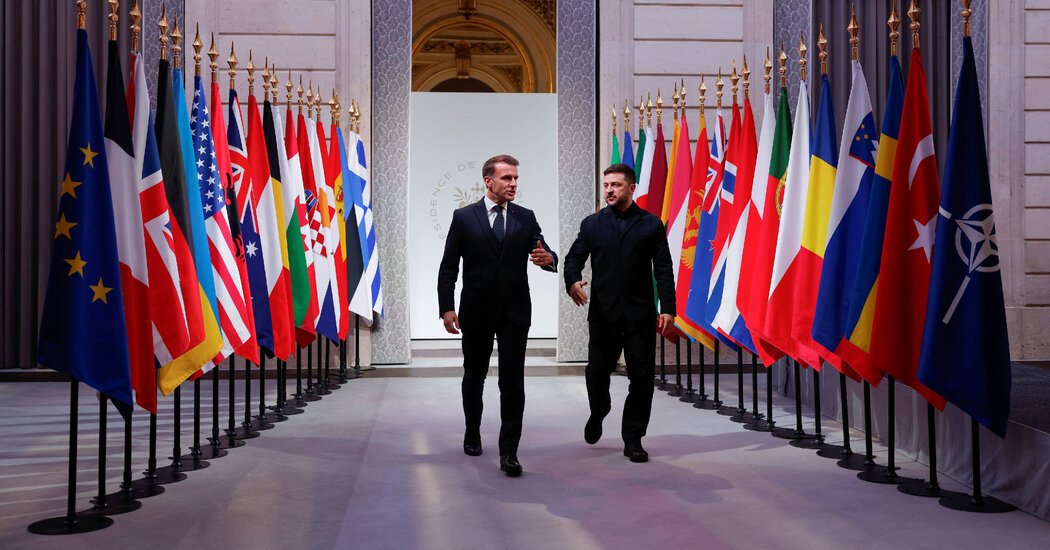
On Tuesday, Ukraine’s allies reached an agreement to establish crucial postwar security measures for the nation in case of a cease-fire with Russia. This includes a statement from the leaders of France and Britain committing troops to deter any future Russian invasions. At a Paris gathering of over 30 European leaders and members of the so-called Coalition of the Willing, President Emmanuel Macron of France, Prime Minister Keir Starmer of Britain, and President Volodymyr Zelensky of Ukraine formalized this agreement. The nations involved have dedicated themselves to enhancing Ukraine’s security. Aside from the troop commitment, the pact indicated that the United States would spearhead efforts to oversee any potential cease-fire, along with forming a special commission to “address any breaches, attribute responsibility and determine remedies.” Britain and France also pledged to set up military hubs throughout Ukraine post-cease-fire to accommodate protected sites for weapons and other resources to support the Ukrainian military. Mr. Zelensky, who had shown more skepticism regarding peace discussions lately, remarked that this signed agreement was just the beginning of what he expected, asserting that the “architecture of security” for his nation under a peace arrangement “now exists.” “This is a significant forward movement because a year ago, we couldn’t even contemplate it,” Mr. Zelensky stated at a press briefing following the meeting. “We are getting a bit closer each day.” Arguably, the most notable sign of advancement for Ukraine during this assembly — the 15th convened since the coalition’s inception — was the appearance of two representatives from President Trump’s team alongside Mr. Zelensky and other European figures. Both negotiators, Steve Witkoff and Jared Kushner, expressed strong support for Ukraine after a year of varying backing from the American president. Mr. Witkoff stated to reporters after the meeting, “Mr. Trump stands firmly with the country of Ukraine and advocates for a peace agreement. We will back the Ukrainians in their pursuit of lasting peace. We are confident we will achieve that.” However, any cease-fire remains unlikely at this stage since Russia is not participating in the discussions and has declared it will not consent to any arrangement allowing NATO troops within Ukraine. “Putin is not indicating he is prepared for peace,” Mr. Starmer remarked, describing the recent Russian aggression toward Ukraine as “appalling.” He added, “That only strengthens our resolve.” In their official proclamation, the leaders pledged to support Ukrainian forces with financial resources and armaments while ensuring “binding commitments” to the nation in the event of a future Russian assault. Despite this, many specifics were left vague. Mr. Starmer highlighted that the commitment merely “establishes the groundwork for the legal framework” regarding British and French military personnel stationed on Ukrainian territory. Additionally, aware of his domestic audience, Mr. Macron indicated that the troops would be stationed well away from any front lines. In a short conversation with public broadcaster France 2 on the sidelines of the gathering, he mentioned that “several thousand” French soldiers might be sent to Ukraine to assist in maintaining peace. Other leaders have proposed commitments for weaponry and additional military assistance, Mr. Zelensky noted, although these suggestions are currently private and pending approval through their nations’ democratic processes. “We are prepared to commit, but the ultimate decision must be made by the cabinet and in Parliament through the legislative procedure, and that will occur just as the peace agreement is nearing completion,” Prime Minister Dick Schoof of the Netherlands stated in an interview post-meeting. The alignment of Europeans, Ukraine, and the United States would convey a robust message to President Vladimir V. Putin of Russia, Mr. Schoof asserted. “I’m confident that President Trump will use all his influence to bring Russia to negotiations because we are now united and have shown that we genuinely desire peace,” he expressed. Tuesday’s meeting took place 11 months after Mr. Macron rapidly assembled European leaders in reaction to Mr. Trump’s indications that he could withdraw American support for Ukraine while engaging with Russia, leaving Europeans — who perceive the war on their soil as a fundamental menace — sidelined. Since that time, European leaders and their military heads have convened numerous times, developing a strategy to assist Ukraine in achieving a cease-fire. Mr. Zelensky and other European leaders have been tirelessly working to secure the American president’s support. Their journey has not been smooth. In November, the Americans endorsed a peace proposal that appeared to align with the Russian agenda. It required Ukraine to surrender territory, limit its military size, and renounce NATO membership, while demanding minimal concessions from Russia. Following another series of meetings among the Coalition of the Willing, a new 20-point plan took shape, more attuned to Ukrainian and European priorities. Mr. Zelensky introduced the plan to Mr. Trump in December, and subsequent meetings at Mar-a-Lago led the Ukrainian leader to declare that the plan was “almost finalized,” even though several contentious matters remain unresolved. Following Tuesday’s gathering, Mr. Zelensky and the Europeans seemed to have successfully engaged the Trump administration — at least for the time being. “Ukraine is receiving something it has lacked since 2022: credible, organized, and multinational security assurances without having to await NATO membership,” remarked Alexandra de Hoop Scheffer, president of the German Marshall Fund of the United States in Washington. “This declaration is securing long-term support for Ukraine. It’s systematic now.” Solid commitments from allies would significantly enhance Ukraine’s leverage in any negotiations with Russia, she noted. Regarding Europe, the meeting’s outcome illustrated that it had “formalized and institutionalized U.S. long-term commitment and a U.S. safety net role,” she added. “Russia is clearly at a strategic disadvantage here,” she stated. Lara Jakes contributed reporting from Rome and Ana Castelain from Paris.
Published: 2026-01-07 06:35:00
source: www.nytimes.com