
How Delcy Rodríguez, Venezuela’s Leader, Became Essential to Trump’s Strategy for the Nation
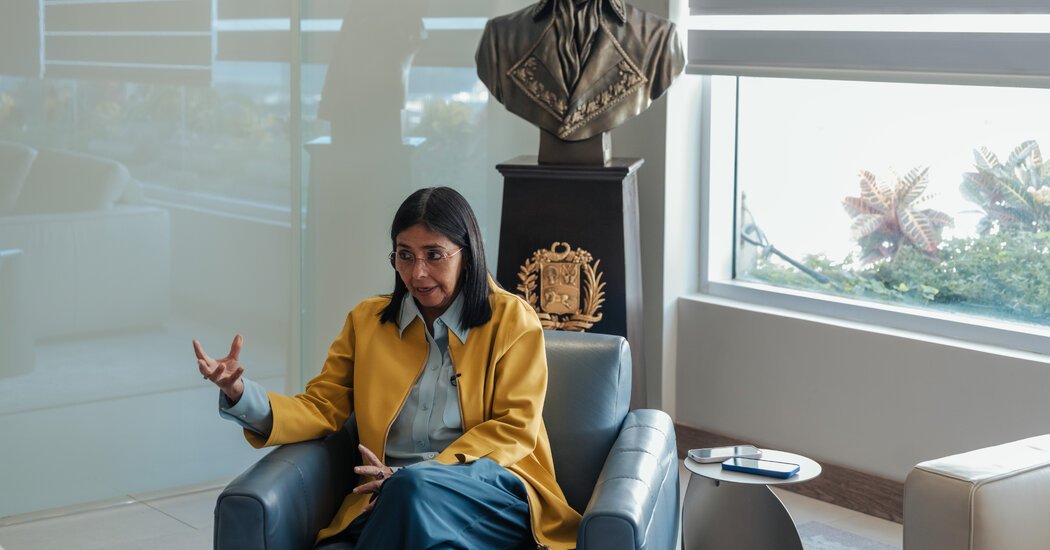
Venezuela’s streets were ablaze with protests against misgovernance. Paramilitary groups and security personnel were killing demonstrators by the scores. In 2014, Delcy Rodríguez, then the foreign minister, called ambassadors from around the globe in an attempt to shift the narrative and fend off sanctions related to human rights violations. During the closed-door session, Ms. Rodríguez admonished representatives from the United States and the European Union, asserting that those killed were terrorists, not protesters. “She was yelling at them, using very aggressive language,” recalled Imdat Oner, a former diplomat at Turkey’s embassy in Caracas who was present. “This is not how a foreign minister should behave. I found it shocking because it completely deviated from diplomatic norms.” Ultimately, Ms. Rodríguez did not succeed, as President Barack Obama moved forward with sanctions. However, her confrontational approach benefitted her as she ascended within a male-dominated government filled with military figures and fiery ideologues. Now, with President Trump’s backing, Ms. Rodríguez serves as Venezuela’s interim leader following the U.S. forces capturing and forcibly removing her predecessor, Nicolás Maduro, along with his spouse, Cilia Flores, to face trial in New York.
Ms. Rodríguez, 56, encounters an immense challenge. She must appease an American president who claims the United States will govern Venezuela for years to come, all while attempting to stabilize a collapsing economy and consolidate her hold on governing institutions and power brokers in her inner circle, who are imbued with animosity toward U.S. interference. Yet, those familiar with her assert that her skill in hurling insults at the West—a virtual job prerequisite in Venezuela’s administration until Mr. Maduro’s removal—is tempered by a pragmatic side, allowing her to endure both internal purges and geopolitical changes. Her evolution from Mr. Maduro’s ideological provocateur to a straightforward technocrat seemingly capable of collaborating with Mr. Trump unfolded as she gained power in recent years, spearheading efforts to steer Venezuela away from an economic disaster characterized by children suffering from starvation.
Educated abroad in France and Britain, she enjoys a distinguished status domestically as the daughter of a Marxist guerrilla who abducted an American business executive and became a revolutionary martyr. As foreign minister, she played a role in the decision-making process aimed at resetting relations with the United States in 2017, coinciding with the start of the first Trump administration. That was when Citgo Petroleum, then the U.S. branch of Venezuela’s national oil company, contributed $500,000 to Mr. Trump’s inauguration. By assembling a new team of economic advisers from Venezuela and overseas, Ms. Rodríguez orchestrated a truce with Venezuela’s economic elite and initiated a covert privatization of natural resources by granting foreign investors control over some prized projects, including oil fields, cement facilities, and iron ore mines.
Up until Mr. Maduro’s ousting, Ms. Rodríguez consistently echoed his resolute, anti-imperialist rhetoric in her public remarks. “The Pentagon has always had a strategic aim of seizing Venezuelan reserves” of oil, she informed The New York Times in a September interview, as Mr. Trump tightened military pressure on Mr. Maduro. “There’s no doubt one of the strategic objectives is what is called regime change.” However, on Friday, just days after the United States captured Mr. Maduro under the cover of darkness, Ms. Rodríguez issued a statement indicating that Venezuela was considering the restoration of diplomatic relations and sending a delegation to Washington. Furthermore, U.S. diplomats visited Caracas, Venezuela’s capital, that same Friday to evaluate a “potential” resumption of embassy operations for the first time in nearly seven years.
Ms. Rodríguez’s earlier attempts to attract investors and business leaders yielded results. Hyperinflation was brought under control, and economic growth resumed, driving Ms. Rodríguez’s ascension to the summit of Venezuelan politics. “We had to re-engineer the economy,” commented Rafael Correa, Ecuador’s former leftist president and a U.S.-trained economist whom Ms. Rodríguez enlisted as an economic adviser starting in 2018, roughly a year after he left office. “It was complete chaos.” In recent years, Venezuela has achieved some of the highest growth rates in Latin America, albeit from direly low levels. Mr. Correa, who continues to advise Ms. Rodríguez, credited the increased stability to her diligence and receptiveness to technical assistance. “She is a workaholic; she never stops,” he noted.
When Mr. Maduro was apprehended, he had already delegated nearly all economic responsibilities to Ms. Rodríguez, who concurrently held the positions of vice president, finance minister, and petroleum minister. Yet, Venezuela’s new leader now confronts what is arguably her most formidable challenge as she navigates between U.S. expectations and domestic pressures. Highlighting the pressure she is under, Mr. Trump informed The Times in an interview last week that she was in ongoing dialogue with Secretary of State Marco Rubio, a disclosure confirmed by someone close to Ms. Rodríguez, who wished to remain anonymous to discuss private matters. Mr. Trump refrained from commenting when questioned if he had spoken with Ms. Rodríguez. Ms. Rodríguez’s government did not reply to requests for statements.
In a speech on Wednesday night regarding the U.S. military actions that Venezuelan officials claim killed at least 100 civilians and military personnel, she stated, “Venezuela is a peaceful nation that was assaulted by a nuclear power.” However, she also highlighted how realpolitik is influencing Venezuela’s renewed relationship with the United States as the Trump administration urges her to provide privileged access to Venezuela’s oil resources for U.S. oil firms. Her technocratic, data-driven communication style was evident on Wednesday, as she shared intricate economic statistics and utilized terms like “Manichaean” to characterize relations with the United States. The tone was a stark contrast to the more informal style of Mr. Maduro, a former bus driver and self-identified “working-class president.”
At the age of seven, Ms. Rodríguez lost her father, a Marxist guerrilla named Jorge Antonio Rodríguez, who led the kidnapping of William Niehous, an American executive at Owens-Illinois, a bottle manufacturing company. Her father was a leader of the Socialist League, a splinter faction that advocated armed struggle during the 1970s and included Mr. Maduro among its members. Mr. Rodríguez passed away in prison in 1976 at the age of 34 after being charged in the Niehous abduction and tortured by intelligence agents connected with a pro-U.S. government. Following her father’s death, Ms. Rodríguez, as the offspring of staunch leftists, effectively grew up amid the turmoil of Venezuelan politics. At the time, Venezuela was a democracy but was controlled by two major political factions, one center-right and the other center-left, sidelining extreme viewpoints.
She graduated with honors with a law degree from one of the leading institutions in the country, the Central University of Venezuela in Caracas. Subsequently, she pursued labor law studies at the Sorbonne, the distinguished French university. Upon return from Paris, Venezuela was undergoing significant political upheaval. Hugo Chávez had come to power, launching his socialism-inspired movement known as the Bolivarian Revolution. She joined the diplomatic corps of his fledgling administration, securing a position in Venezuela’s embassy in London, where she studied politics at Birkbeck College.
Her mother, who shares her name, Delcy, is a political activist sometimes referred to as the “Matriarch of the Revolution.” She is known to be very close to her daughter and accompanied her during her time in London. The languages Ms. Rodríguez mastered while studying overseas, particularly her command of English, set her apart in a government where senior officials typically spoke only Spanish. After returning to Caracas, she was frequently observed conversing in French with African diplomats. By this point, her father had become a symbol of martyrdom for Venezuela’s revolution. Her elder brother, Jorge Rodríguez, also rose to prominence as a top aide to Chávez and at one time served as his vice president. Currently, he heads the National Assembly, positioning the siblings in leadership roles within two branches of the government.
After Mr. Chávez’s death in 2013, she began her rapid ascent in the Maduro administration under her brother’s mentorship, according to people familiar with her trajectory. Several Venezuelan and international businessmen who have encountered Ms. Rodríguez have expressed admiration for what they describe as her grasp of technical matters as well as her eloquence and wit. They noted that she was always impeccably attired, asked insightful questions, and made subtle humorous remarks. Some of these businessmen have characterized her as a micromanager obsessed with control, asserting that she insists on personally signing every document, including the most trivial approvals. This method introduced a degree of order to Venezuela’s chaotic bureaucracy but resulted in a growing backlog of proposals awaiting her authorization.
To facilitate her rise, she marginalized rivals, as noted by multiple individuals close to the administration. Notably, she played a significant role in the resignation and eventual imprisonment of Tareck El Aissami, a protégé of Maduro who oversaw the oil sector, according to these sources. Those who spoke to The Times about Ms. Rodríguez requested anonymity to discuss confidential conversations or due to fears of retaliation. Her supporters allege that her work obsession is fueled by her vision for Venezuela’s economic development; critics contend that she seeks control for its own sake, indicating a broader ambition for power.
She has depended on a tightly-knit team of market-friendly officials to implement her economic initiatives. Key figures include Román Maniglia, who currently manages Venezuela’s leading public sector bank, and Calixto Ortega Sánchez, whom Ms. Rodríguez appointed recently as the new finance minister. After assuming control of the economy, she recruited two economic advisers from Ecuador, who became the primary drivers of her stabilization strategy. The advisors, Patricio Rivera and Fausto Herrera, had previously served under Mr. Correa, Ecuador’s former president. While Ms. Rodríguez had earlier embraced the confrontational rhetoric of Venezuela’s regime, acquaintances note that she is also fond of high-end clothing brands and gourmet dining. She is childless and has never been married.
Those who are familiar with her indicate that she is very close to her family, dedicating much of her leisure time to her mother, her brother Mr. Rodríguez, and his children. Although she was raised as a Catholic, she has since adopted a broader spiritual perspective that has not been emphasized in her tough public persona. Ms. Rodríguez follows Indian guru Sri Sathya Sai Baba, who passed away in 2011 and faced allegations of sexual abuse and money laundering. Other notable followers of the guru in Venezuela include Mr. Maduro and his spouse, Ms. Flores. Followers are expected to adhere to the fundamental principles of truth, peace, and love. Ms. Rodríguez is “a disciple of Sai Baba” who has visited the guru’s ashram and frequently paid her respects to him, said an official from the Sri Sathya Sai Central Trust, who asked not to be named due to a lack of authorization to speak with the media. The ashram is located in Puttaparthi, in the southern Indian state of Andhra Pradesh. On her visits in recent years, she was seen wearing a kurta, a style of loose collarless shirt, as she walked through sacred areas, often folding her hands in homage before the guru’s life-sized portrait and statue. Reporting was contributed by Mariana Martínez from Caracas, Julie Turkewitz from Maryland, Pragati K.B. from New Delhi, and José María León Cabrera from Quito, Ecuador.
Published: 2026-01-10 16:37:00
source: www.nytimes.com