
Long Before Bondi Massacre, Australian Jews Lived With a Sense of Peril
Throughout Rebecca Di Veroli’s 33 years growing up Jewish in Australia, an underlying sense of vulnerability has been ever-present, as integral to her life as the sun, surf, and sand. Armed security personnel were stationed outside each synagogue, every childcare facility, and even the Jewish nursing home she frequented to visit her grandfather. The Jewish schools she attended were enclosed by imposing walls. Her father, who escaped Poland amid a pogrom, prohibited the family from participating in Jewish events, especially in open areas like parks. “Come on, we’re in Australia. Don’t be absurd,” she remembered saying to him. Last Sunday evening at Sydney’s Bondi Beach, she found herself lying still on top of her 5-year-old son beneath a food table, attempting to shield his small frame with her own as gunfire erupted around them. Nearby, a rabbi who had been serving hot dogs moments before was struck in the chest and was struggling to breathe.
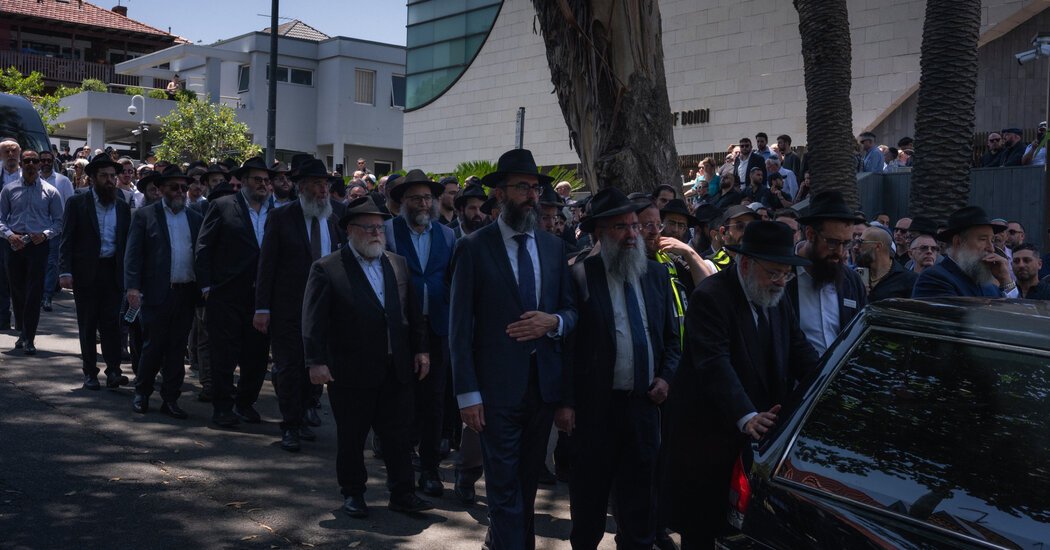
For members of Australia’s close-knit Jewish community, the violent assault on the Hanukkah celebration was their ultimate nightmare realized. Their deep-seated fears had intensified in the wake of the Hamas-led attack on Israel on October 7, 2023, along with Israel’s subsequent conflict in Gaza that prompted a surge in antisemitic rhetoric and acts of vandalism. The sense of insecurity was profoundly heightened for a community where many can trace their heritage back to Holocaust survivors. They grew up in families that had fled to the furthest reaches of the globe from European persecution. Jews who escaped Hungary sought refuge near picturesque Bondi Beach, which became relatively affordable after World War II. For many years, their families convened on the beach for bar and bat mitzvahs, prayer gatherings, and the annual Hanukkah celebration, which included a petting zoo and face painting. The two attackers who opened fire at this year’s celebration, resulting in 15 deaths, were reportedly motivated by the terrorist organization Islamic State, according to authorities.
The massacre came on the heels of a series of antisemitic incidents in Australia over the past two years, including the arson of synagogues and the burning of Jewish-owned businesses. In response, the federal government increased police security, tightened hate crime legislation, and pledged millions of dollars for protective measures. Following Sunday’s incident, numerous Jews expressed that Prime Minister Anthony Albanese’s government had not acted swiftly enough, despite its own antisemitism envoy, Jillian Segal, presenting an extensive list of suggested actions in July. “We haven’t been feeling safe in Australia,” stated Wayne Miller, 50, who relocated from South Africa in 2008 after facing violent crime there. Mr. Miller attended Sunday’s event with his two daughters, aged 3 and 4. “We feel as though our government has let us down.”
Ms. Di Veroli’s two children, 7-year-old Chloe and 5-year-old Louie, encountered antisemitism earlier this year when their school was defaced with crude graffiti targeting Jews. The institution temporarily closed, and uniformed police patrolled the premises for weeks in addition to the regular armed guards. When her children inquired why their school had been vandalized, Ms. Di Veroli found it challenging to articulate a response. She simply told them that there are unkind individuals in the world. The morning following the Bondi Beach shooting, Louie was once more full of inquiries. The mother felt even more unsure about how to explain why their Jewish identity had made them a target for such animosity. “It’s difficult. We don’t have the answers ourselves,” she remarked.
Many Jewish Australians reported that their sense of belonging in the country was shaken just two days after the attacks on October 7, when pro-Palestinian demonstrators gathered on the steps of the Sydney Opera House, some shouting antisemitic slogans. As the conflict in Gaza continued, many expressed difficulty in wanting to openly affirm their Jewish identity while fearing that such expressions could render them vulnerable to violence. In an online community forum on the website of a news outlet, The Jewish Independent, one man wrote that it felt “a bit like walking on one of those rickety rope bridges.” Irene Fihrer, a psychologist conducting group and individual therapy sessions after Sunday’s assault, said a number of Jewish patients approached her after worrying their previous therapists were against Israel’s actions in Gaza, which too often seemed to conflate with animosity towards Jews. She noted that her own daughter, enrolled in a Jewish school with Hebrew on its emblem, became hesitant to wear her uniform in public after being verbally abused with her friends and having objects hurled at them in a shopping mall. “Every little aspect of your life magnifies your awareness, realizing this could pose a danger for me,” Ms. Fihrer said.
Sarah Schwartz, a human rights attorney in Sydney, co-founded the Jewish Council of Australia after the war began in Gaza to counter right-wing narratives from Jewish organizations that unconditionally supported Israel. She warned that Jews would suffer if responsibility for the Bondi Beach massacre is placed on the Palestine solidarity movement or immigration, rather than solely on the ideology of Islamic State. “If those divisive messages prevail, it will only exacerbate resentment and antisemitism directed at Jewish individuals,” she asserted. Similar to Ms. Di Veroli, Jessica Chapnik Kahn has spent the days following last weekend’s attack grappling with what to communicate to her children and how much to reveal. She had also thrown herself over her 5-year-old daughter on the concrete floor of a picnic area, where other frightened parents attempted to keep their children calm and quiet so that the shooters wouldn’t target them. Her daughter, Shemi, lay so still that she worried she might have suffocated her. Her 9-year-old son, who ran barefoot with his father towards the shooting to locate his mother and sister, later asked, “Why would someone do that at a Hanukkah party?” “When you hear a child trying to understand it, the absurdity becomes even more pronounced,” she said.
Ms. Chapnik Kahn indicated that her children were quite conscious of their Jewish identity, but she and her husband had avoided letting them learn about antisemitism, World War II, and Hitler just yet. To her son, she responded as honestly as she could. “Some people out there make terrible decisions,” she said. “They allow their hatred to dominate them and mistakenly believe that causing harm to others will bring them happiness.” Livia Albeck-Ripka contributed reporting.
Published: 2025-12-21 05:36:00
source: www.nytimes.com