

China Launches Rockets Near Taiwan in Show of Military Strength
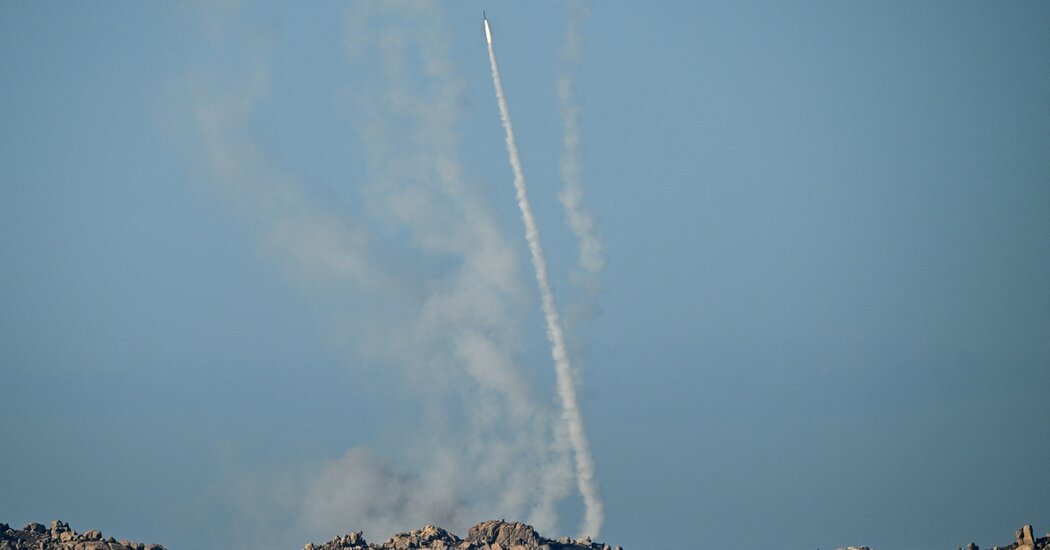
On Tuesday, China escalated its military drills near Taiwan by firing long-range rockets into the waters surrounding the island. The People’s Liberation Army also deployed new amphibious assault vessels, alongside its ships and aircraft practicing tactics to repel a potential enemy force, showcasing its capability to both strike and isolate the island. Taiwanese defense official Gen. Hsieh Jih-sheng reported at a Taipei news conference that Chinese long-range artillery units discharged 27 rockets into designated live-fire zones to the north and southwest of Taiwan. China’s primary state broadcaster, CCTV, reported that numerous rockets impacted the sea north of the island. The Chinese military stated that its destroyers, frigates, and fighter-bombers were active in nearby regions, testing their capacity to detect and engage enemy aircraft, vessels, and submarines. They advised that ships and aircraft not taking part in the exercises stay clear of seven live-fire zones, which would remain active until evening.
Taiwan’s Ministry of National Defense noted that 11 Chinese naval vessels and eight coast guard ships approached within 24 miles of Taiwan’s coast, an area where Taiwan enforces its laws. The ministry indicated that Taiwanese forces issued radio calls requesting their departure. The two-day exercises, named “Justice Mission 2025,” commenced the previous day with a show of force involving Chinese bombers, fighter jets, warships, drones, and missile units, accompanied by assertive rhetoric and martial-themed videos on the internet. “While the troop numbers may not have been the highest, the scale of the exercises continues to expand,” Gen. Hsieh remarked. “The message is abundantly clear — they regard the Taiwan Strait as their internal waters,” he added.
According to Chieh Chung, a researcher at the Institute for National Defense and Security Research in Taipei, which operates under the Taiwanese defense ministry’s auspices, China’s maneuvers seemed aimed at signaling that the People’s Liberation Army is refining its capacity to sever Taiwan from any external aid during a conflict. Chieh observed that several exclusion zones seemed designed to prevent advances by the Japanese Self-Defense Forces or U.S. forces stationed in Japan, stating, “The positioning and vast expanse of these zones indicate a message of ‘I will keep foreign forces at bay.’” These drills followed the Trump administration’s announcement of over $11 billion in proposed arms sales to Taiwan. The rockets were launched by Chinese long-range artillery units positioned in Fujian, the mainland province across from Taiwan, and landed beyond the 24-mile limit, as reported by Taiwan’s Ministry of National Defense.
The Taiwanese coast guard indicated that the Chinese units utilized PCH191 launchers, a nimble and relatively cost-effective weapon that China has produced in larger quantities as a substitute for larger, more expensive missile systems. A video released by China’s military illustrated one of these launchers, which is truck-mounted, discharging a series of rounds that the footage indicated landed in a designated sea area near Taiwan. Military experts have noted that in a real conflict, Taiwan might struggle to intercept rockets fired from such mobile units. “They can essentially fire from anywhere along their coast, reaching most, if not all, of Taiwan,” remarked Joshua Arostegui, research director at the China Landpower Studies Center at the U.S. Army War College and author of a paper regarding the PCH191 launcher, in a previous interview.
Additionally, China’s military indicated that it had dispatched amphibious assault ships, other naval vessels, and aerial drones east of Taiwan, where training maneuvers included “precision strike operations” and the seizing of key ports. This direction is where the U.S. or its allies might advance in an effort to support Taiwan. Chinese leaders have long asserted that Taiwan is a lost territory of their country and have stated they may resort to military action if peaceful unification seems unattainable. Since 2022, China has engaged in six significant military exercises near Taiwan, expressing its displeasure with the island’s government, which has labeled Beijing a threat to its democracy and autonomy. The ongoing exercises marked the end of an eight-month period of relative calm in the Taiwan Strait. With the sudden renewal of drills, China’s leader, Xi Jinping, appears to be reinforcing a reminder to Taiwan, prospective allies, and even the Chinese populace that the People’s Liberation Army remains poised to strike if commanded.
“External forces have recently crossed the line repeatedly on the Taiwan issue, recklessly trying to embolden and support ‘Taiwan independence’ separatist factions,” stated Zhang Xiaogang, a spokesperson for China’s Ministry of National Defense in comments released late on Monday. These exercises occurred just a week after Mr. Xi appointed a new commander for the Chinese military’s Eastern Theater, the region that encompasses Taiwan, and seemed to engage in realistic training for a possible offensive or blockade of the island, noted Ben Lewis, founder of P.L.A. Tracker, a site monitoring Chinese military operations, in an interview. “It appeared that the Eastern Theater Command was eager to test and illustrate its capacity to swiftly mobilize forces to, as they indicated, assert total control of maritime and aerial realms,” Lewis added. “They were able to rapidly transition from a routine posturing to a military exercise or attack posture.”
Moreover, China may be attempting to intimidate Japan, particularly in light of Prime Minister Sanae Takaichi’s recent indications that her nation could provide assistance to Taiwan if China were to initiate an attack, and her resolve in the face of Chinese threats and boycotts. Chinese authorities seem to be trying to convey the message that “Japan would and could do nothing” to defend Taiwan, commented Yun Sun, director of the China Program at the Stimson Center in Washington. “In my view, the situation concerning Japan is the principal motivation behind China’s decision to conduct these military exercises,” she remarked. “China has placed itself in a position where it can accept nothing less than Takaichi’s formal retraction of her statement, which is unlikely to occur.” Mr. Xi seems to be operating under the assumption that two days of drills will not disrupt ties with Mr. Trump prior to a scheduled summit in April, experts noted. During the Beijing summit, Mr. Xi may attempt to convince Mr. Trump to take a stance against Taiwanese independence or at least reiterate the longstanding U.S. position of non-support for moves towards independence, suggested Bonnie S. Glaser, managing director of the Indo-Pacific program at the German Marshall Fund of the United States. During a Monday news conference, when asked about the recent exercises, Mr. Trump appeared untroubled. “They’ve been doing that for 20, 25 years,” he noted.
Published: 2025-12-30 15:25:00
source: www.nytimes.com