
After President’s Capture, U.S. and Venezuela Look to Restore Diplomatic Relations
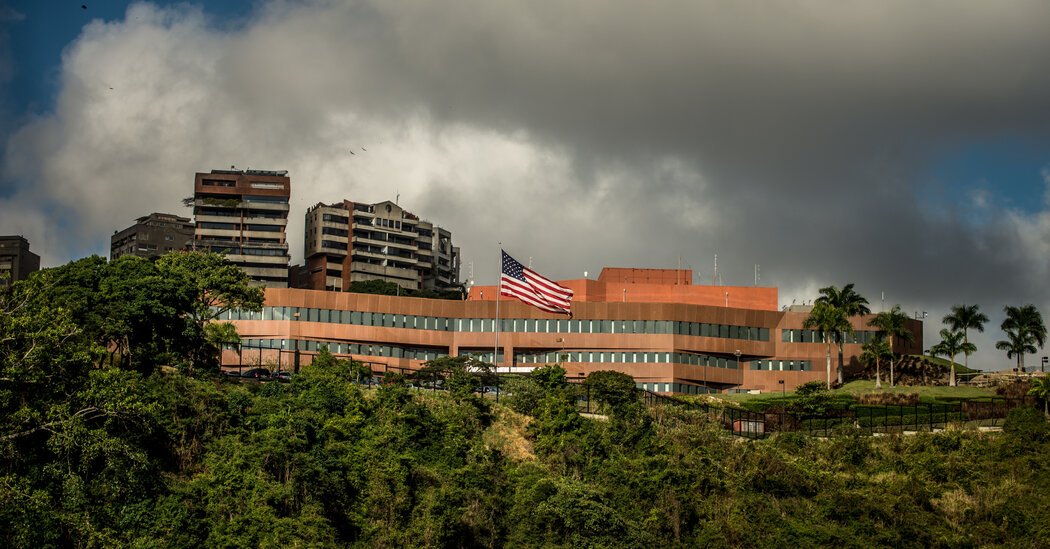
Just days after the United States apprehended its president under the cover of darkness, Venezuela announced that it was considering the reinstatement of diplomatic relations and planning to send a delegation to Washington to review its long-closed embassy, according to a statement from interim president Delcy Rodríguez. Her administration and President Trump’s, as per Ms. Rodríguez, had agreed to “begin an exploratory diplomatic process” aimed at the re-establishment of diplomatic missions between the two nations. On Friday, U.S. diplomats made a visit to Caracas, the capital of Venezuela, to evaluate a potential revival of embassy activities for the first time in almost seven years, as confirmed by a spokeswoman for the State Department. The announcements made on Friday seem to indicate only preliminary steps, and experts observed that the dynamics between the two nations are shifting on a daily basis. However, the news regarding the revival of diplomatic relations attracted attention not only due to the rapid developments in the bilateral relationship but also because of the perplexing contradictions it appeared to highlight. This came as Mr. Trump proclaimed he was on “extremely good” terms with Venezuela’s government, despite that government being largely unchanged from a week ago — apart from President Nicolás Maduro — when Mr. Trump was intensifying his pressure campaign. Additionally, Vice President JD Vance acknowledged that the U.S. military had been “empowered” by Mr. Trump to target drug cartels — presumably the same groups that a federal indictment claimed were closely associated with the Venezuelan government. To further complicate matters, Ms. Rodríguez made her announcement in a statement that commenced with denouncing the “kidnapping” of Mr. Maduro and a U.S. operation that she asserted had resulted in numerous fatalities and constituted a blatant violation of the “international legal order.” She remarked that Venezuela was commencing the “diplomatic exploratory process” in order to “address the repercussions stemming from the aggression and the kidnapping of the president of the republic and the first lady, as well as to pursue a collaborative agenda of mutual interest.” On Friday, Mr. Trump was urging American energy executives to swiftly capitalize on Venezuela’s extensive oil reserves, while the U.S. military intercepted another tanker carrying oil from Venezuela. The U.S. Embassy in Caracas has remained closed since early 2019, when Mr. Maduro expelled U.S. diplomats there in response to Washington’s recognition of opposition leader Juan Guaidó as interim president following an election that the United States criticized for being undemocratic. Concurrently, Mr. Maduro closed the Venezuelan Embassy in Washington, a modest brick structure located in the Georgetown area. The U.S. Embassy in Caracas occupies a sprawling yet unremarkable building, more practical than impressive, situated in an upscale hillside neighborhood. In the past, it was bustling with individuals waiting for U.S. visas and hosted a well-known Fourth of July gathering involving the Marines. For years now, it has remained dark. Elliott Abrams, who served as a U.S. envoy to Venezuela during the first Trump administration, mentioned that reopening the embassy was not simply a matter of “flipping a switch” but brought forth practical challenges — from mold that may have developed in Caracas’s humid climate to concerns over diplomats’ safety in the city — alongside potential legal ramifications. Considering the prospect of resuming diplomatic relations with Venezuela, he noted the issue of whether the United States would now recognize Ms. Rodríguez as the legitimate leader of the state. “If Delcy Rodríguez, who was appointed vice president by Maduro, is the legitimate interim president, doesn’t that imply that you consider Nicolás Maduro a legitimate president?” he questioned. “And if you do, doesn’t that have implications for his trial? Does he possess head-of-state immunity?” Mr. Abrams continued, referencing a principle in international law that protects current leaders from criminal prosecution in foreign courts. Legal experts observed that in specific situations, the United States granted recognition to individuals who were not the official leaders of their nations. For instance, the U.S. recognized Libyan and Syrian rebels. As per the U.S. State Department spokesperson, diplomats and security personnel from the Venezuela Affairs Unit of the U.S. Embassy in Colombia, including chargé d’affaires John T. McNamara, arrived in Caracas on Friday to “perform an initial evaluation for a possible phased resumption of operations.” Flight-tracking information indicated that two U.S.-registered aircraft traveled from Colombia and the U.S. to Venezuela this week, with stops on the island of Curacao. Venezuela’s government did not immediately respond to a request for comment regarding the announcement or the identity of those who would be traveling to Washington as part of its delegation. However, Ms. Rodríguez’s communications minister, Freddy Ñáñez, stated in a social media message that the interim president had no intention of leaving the country and would be concentrating on domestic matters. On Friday, Ms. Rodríguez posted a message indicating she had consulted with leftist leaders in Latin America and Spain about the “armed attacks against our territory” — but also addressed what she referred to as the “necessity to promote a comprehensive agenda for bilateral cooperation.” Anatoly Kurmanaev, Riley Mellen, and Sheyla Urdaneta contributed reporting.
Published: 2026-01-10 04:38:00
source: www.nytimes.com