

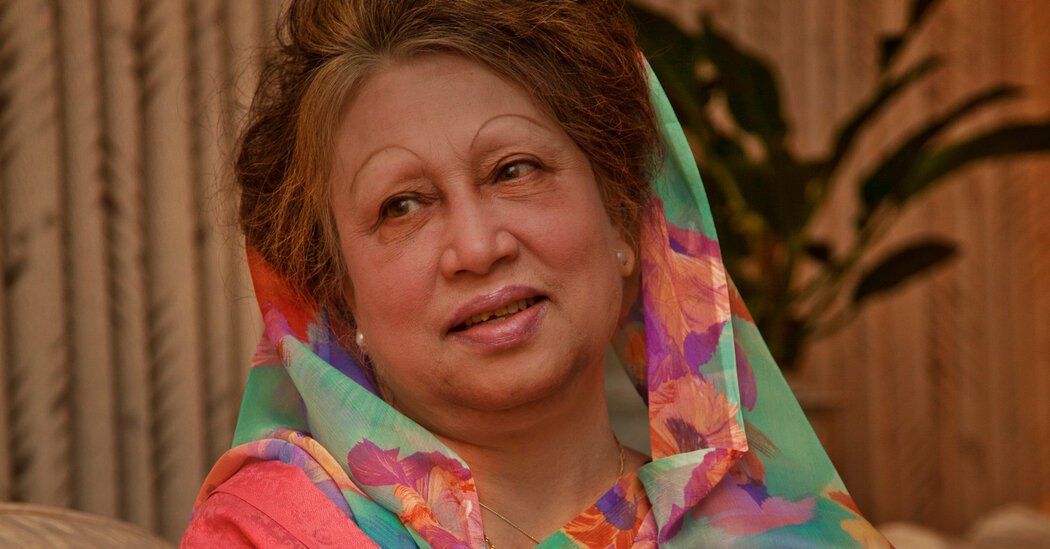
Khaleda Zia, Bangladesh’s First Female Prime Minister, Passes Away
Khaleda Zia, the inaugural female prime minister of Bangladesh, whose long-standing rivalry with another influential woman in a competing political dynasty influenced the destiny of the burgeoning South Asian nation, passed away on Tuesday in a hospital situated in Dhaka, the capital of Bangladesh. She was reported to be around 80 years old. The Bangladesh Nationalist Party, where Ms. Zia held the position of chairperson, confirmed her passing through a statement on its official social media account. The statement did not provide details regarding the cause of her death. Ms. Zia, being the widow of one of the initial military rulers in the tumultuous 50-year history of Bangladesh as an independent country, completed two full terms and one abbreviated term as prime minister. Over the last thirty years, she alternated as the principal elected leader of Bangladesh with Sheikh Hasina, the daughter of the country’s murdered founding president, who became increasingly authoritarian until her removal following deadly protests last year.
During her final decade, an unwell Ms. Zia was pursued by her political opponent, who kept her either imprisoned or under house arrest as numerous legal challenges accumulated against her. She frequently required hospitalization under armed protection, suffering from various age-related ailments including rheumatoid arthritis, diabetes, and severe liver issues. When her health deteriorated after contracting Covid in 2021, medical professionals recommended that she seek treatment abroad. However, the courts under Ms. Hasina’s administration denied multiple requests made by her attorneys. At that time, Bangladesh’s foreign minister, A.K. Abdul Momen, remarked that Ms. Zia could bring any physician of her choice to Bangladesh for her care but would not be permitted to travel overseas.
Ms. Zia was released from house arrest, and nearly a dozen cases filed against her were dismissed following Ms. Hasina’s ousting and subsequent flight from the country. However, she continued to be bedridden. Regardless of her hospitalization, her party still put her name forward to compete for three seats in the upcoming election scheduled for February. From her hospital bed, Ms. Zia rejoiced in Ms. Hasina’s downfall, calling it “the end of tyranny.” “Through a prolonged movement of struggle and sacrifice, we have liberated ourselves from the fascist, illegal government,” she articulated from a statement, breathless, marking her final public expression.
Born Khaleda Khanam Putul in either 1945 or 1946 in the Dinajpur District of what was previously the Bengal Presidency of undivided India under British rule, she was the third of five children. The precise date of her birth has been a source of debate in Bangladeshi politics. Her father, Iskandar Majumder, was a tea trader, while her mother, Taiyaba Majumder, was a homemaker. According to her party’s literature, she attended high school in Dinajpur, though the specifics of her higher education remain uncertain. Many aspects of her life were influenced by two partitions of the subcontinent. Following the division of India in 1947, her family relocated to Pakistan when she was still a young child. In 1971, East Pakistan would secede, forming the independent nation of Bangladesh, after enduring years of brutal cultural suppression against ethnic Bengalis by the Pakistani military.
In the 1960s, she wed Ziaur Rahman, a Pakistani army officer who later emerged as a central figure in the Bangladesh independence movement and ultimately became the leader of the nation’s military. He was known as General Zia. Bangladesh descended into violent turmoil in 1975, initiating a cycle of bloody coups and counter coups when its founding leader, Sheikh Mujibur Rahman, was murdered by a group of military officers in a late-night assault at his residence that decimated most of his family. One of his two surviving daughters, Sheikh Hasina, would inherit his political legacy, maintaining a lasting grudge that significantly influenced her political trajectory. General Zia, who was the deputy chief of the army at the time of the assassination, ascended to become the top military authority and laid claim to governance after two years of tumultuous intrigue. However, he, along with several of his bodyguards, met his demise in another coup in 1981 while visiting Chittagong.
Ms. Zia formally entered the political arena soon after, joining the B.N.P. and swiftly rising to lead the party. However, Bangladesh once again fell under military rule, as army chief Gen. Hussain Muhammad Ershad deposed the interim president completing General Zia’s term and declared himself the country’s leader in 1983. It was the struggle against General Ershad’s dictatorship that temporarily united the two prominent rival women, orchestrating a substantial movement towards the restoration of democracy. Ms. Zia abstained from elections held under martial law in 1986 and was often placed under house arrest. The intensity of the protests led to frequent street confrontations between her supporters and police forces.
Her backers reminisced about her first five-year term as a period marked by significant progress in primary education, especially for girls, along with substantial economic transformations, notably due to the growth of the clothing-export sector, which aided the nation in ascending from dire poverty. This achievement helped Bangladesh shake off the stigma attached by Western nations, including the United States, of being an economic basket case. Ms. Zia took particular pride in having bolstered the involvement of women in a predominantly Muslim society. “We allow and encourage women to engage in all spheres of national life,” she declared in an interview with The New York Times in 1993. “We are indeed a religious population, but we are neither extremists nor fanatics, and thus our approach is more progressive, and we believe our women enjoy greater freedom.” Her second term was cut short due to an opposition boycott of the election, leading Parliament to agree on a re-election under a neutral caretaker government—an election that Ms. Zia lost to Ms. Hasina’s party, thereby granting her rival her initial term in leadership.
Ms. Zia reclaimed power in 2001, elected in coalition with various Islamist parties. However, she became increasingly embroiled in controversies over rising Islamist militancy within the coalition and numerous corruption accusations involving her close associates—including her sons—plights which Ms. Hasina capitalized on to reclaim power. Her downfall began toward the end of her third term, as the military-backed caretaker government overseeing elections arrested her on corruption allegations. Ms. Hasina also faced detention around the same time. Both leaders were released shortly before parliamentary elections, which Ms. Hasina won, securing her position as prime minister for the subsequent 15 years. According to some accounts, during their time of detention, Ms. Hasina and Ms. Zia were held in residences not far from each other, with Ms. Hasina reportedly sharing her food with Ms. Zia.
However, in an interview with The New York Times during her final year in office, Ms. Hasina denied this claim. She asserted that Ms. Zia was confined in a “newly constructed residence.” “A better place, complete with upgraded furniture and amenities,” Ms. Hasina noted. “In my case, it was all old, dilapidated.” Motivated by the loss of her family, which she mentioned in almost every public discourse, Ms. Hasina partially blamed General Zia and his affiliates for conspiring against her father. Ms. Zia’s difficulties intensified in 2009 when she was removed from a government residence that her family had occupied for over thirty years. Many perceived this as retribution from Ms. Hasina, who had been evicted from her government-allotted home during Ms. Zia’s tenure in 2001. As Ms. Hasina consolidated her control, the corruption allegations against Ms. Zia mounted, reaching into dozens. In 2018, Ms. Zia was sentenced to five years in prison for misappropriating funds from the state’s orphanage programs, a sentence later extended to ten years.
In September 2023, a report published in The New York Times determined that Bangladesh’s multiparty democracy was being “methodically stifled” in overcrowded courtrooms, where B.N.P. supporters encountered a perplexing array of “typically vague” charges presented by the authorities. The evidence was described as “weak, at best,” according to the report. Among the accusations leveled against Ms. Zia was that she had misrepresented her birthdate, converting August 15, a day of mourning for Ms. Hasina commemorating the assassination of her family, into a day of celebration for herself. When Ms. Zia failed to appear at a court session regarding a complaint filed in 2016 by a supporter of Ms. Hasina’s party, the court issued an arrest warrant for her. “The complaint claimed she had been celebrating a false birthday on August 15 for many years,” conveyed Syed Nazrul Islam, a lawyer associated with the B.N.P.’s legal division. “However, the truth is, that is indeed her actual birthday.” Ms. Zia is survived by her son Tarique Zia, who has been leading the family’s party from exile in the United Kingdom since 2008, but returned to Bangladesh last week. Her second son, Arafat Rahman, passed away from cardiac arrest in 2015. Alan Cowell contributed to this report.
Published: 2025-12-30 07:10:00
source: www.nytimes.com