

More Than 2,000 Dinosaur Footprints Are Found in the Italian Alps
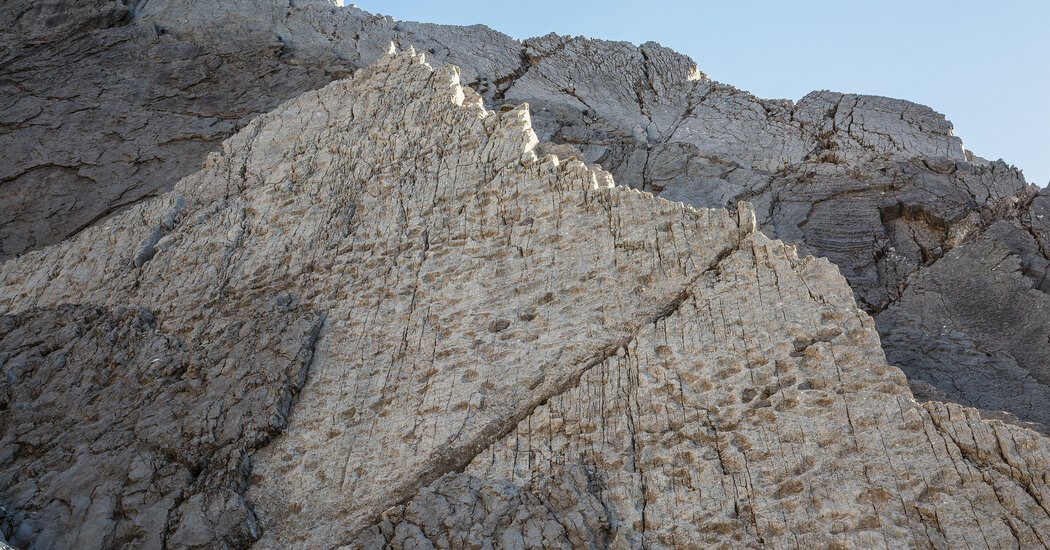
A wildlife photographer aiming to capture images of bearded vultures and red deer in the Italian Alps stumbled upon a remarkable collection of dinosaur footprints, which experts are calling “extraordinary.” The discovery within Stelvio National Park, close to the Swiss border, was announced Tuesday and includes thousands of fossilized footprints over 200 million years old. The tracks, some extending for great distances, are preserved so well that impressions of toes and claws are clearly visible. While working on a project in Lombardy, Italy, in mid-September, Elio Della Ferrera, the photographer, noticed “something unusual” through his telephoto lens. Having experience with paleontological projects, he understood he had found something significant.
Mr. Della Ferrera was eager for a closer examination. Navigating through thick woods without established trails, he trekked for approximately two hours up steep gradients. “It was quite a challenge,” he remarked. “The final few hundred meters were particularly tough due to their steepness, and there’s a loose layer atop a hard surface.” “But I finally reached the spot where these footprints were.” The tracks are believed to have been created by prosauropods, herbivorous dinosaurs with elongated necks from the later phases of the Triassic Period, and they are related to the brontosaurus.
Mr. Della Ferrera speculated that he might have previously encountered and photographed this site without realizing its significance. “I likely spotted them before and may have taken photographs, but I discarded them at the time because I was focused on capturing stunning images for competitions and other assignments,” he shared in an interview. This time, he recognized the importance of what he had discovered.
He estimated observing around 2,400 prints on a single vertical surface. “It is truly astounding,” he stated. Cristano Dal Sasso, a paleontologist at Milan’s Natural History Museum, mentioned in an interview that he had never come across anything like it in his 35 years of experience. He described the find as “a reality more incredible than fiction.” Not only had he never seen tracks in such abundance, but the parallel orientation of the footprints indicated social behavior, “showing animals that walked together, which is uncommon for the Triassic Period,” he remarked, enhancing the significance of the discovery.
It also marked the first occurrence of footprints found in the Lombardy region of Italy, which once resembled present-day tropical locales and was “very different from what we see today,” according to Dr. Dal Sasso. At the time, only northern Italy was connected to the rest of Europe; southern Italy remained submerged, and the footprints were located on what would have been a coastline. Dr. Dal Sasso noted that his team of specialists only had a few weeks to closely investigate the tracks before weather conditions changed. “The real research will commence next year,” he commented. “This was just an initial study.”
Situated high on a mountainside, with no paths available, the footprints are challenging to access, which may explain why they had not been previously discovered. Future examinations of the site could primarily involve drones and remote sensing technologies. The location is not far from Bormio, where Alpine skiing events are set to take place during the Winter Olympics in February. “It appears to be a very impressive new site,” remarked Richard J. Butler, a paleobiology professor at the University of Birmingham, who was not part of the discovery team. “Large dinosaur track locations from the Triassic Period, being the earliest phase of dinosaur evolution, are relatively scarce compared to later epochs, making this a highly significant find.”
“What’s particularly astonishing is that this location, which must have been exposed to the elements for thousands of years, went unnoticed until now, considering it is in Italy,” he added. “This likely reflects how remote and difficult to reach some of these mountainous areas are.” The footprints were found on a nearly vertical surface, yet the prosauropod wasn’t a Triassic Spiderman. The land was level when the footprints were created, only to be uplifted over millions of years as the Alps were formed.
Published: 2025-12-18 01:30:00
source: www.nytimes.com