

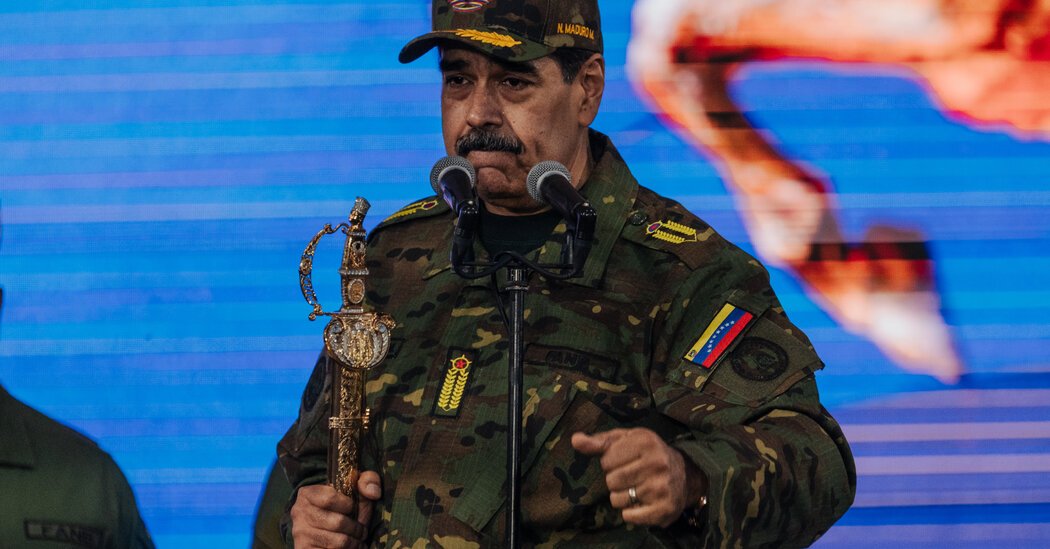
The U.S. Indictment of Maduro Mentions Cocaine Trafficking. Venezuela’s Involvement in the Trade Is Thought to Be Limited.
On Saturday, the United States disclosed an indictment against Nicolás Maduro, the president of Venezuela, accusing him of narco-terrorism and conspiracy to import cocaine. This four-count indictment also implicates Mr. Maduro’s spouse, his son, two senior Venezuelan officials, and an alleged leader of the Tren de Aragua organization, a gang labeled as a terrorist organization by the Trump administration last year. President Trump has stated that Tren de Aragua functions alongside Mr. Maduro’s administration, a claim that has been contradicted by U.S. intelligence agencies. The indictment alleges that Mr. Maduro and his associates have collaborated for decades with prominent drug trafficking organizations to transport substantial amounts of cocaine to the United States. It comes after months of intensifying pressure on Mr. Maduro, which culminated with his capture by the U.S. military in Caracas, the capital of Venezuela. He arrived in New York on Saturday afternoon and will be transported by helicopter to Manhattan for trial. The pressure campaign initiated in September with deadly attacks by U.S. forces on small boats that the Trump administration claimed were transporting drugs from Venezuela to the U.S. The administration has defended these actions by claiming that the U.S. is in an armed struggle against drug cartels and vowed to dismantle trafficking networks. Many analysts argue that these strikes are unlawful. President Trump has claimed that the campaign is aimed at combating drugs that are harming Americans; however, most U.S. overdoses involve fentanyl, which is not sourced from South America, experts indicate. According to U.S. authorities, fentanyl—which leads to tens of thousands of overdoses each year—is predominantly manufactured in Mexico with chemicals from China, and Venezuela is not known to be involved in its distribution, nor is any other country in South America. The indictment made public on Saturday emphasizes almost entirely Venezuela’s lengthy involvement in the cocaine trade. It charges Mr. Maduro and his conspirators with closely collaborating with some of the largest drug trafficking entities in Colombia and Mexico. These include groups such as the Revolutionary Armed Forces of Colombia, referred to by its Spanish acronym FARC, and the Sinaloa Cartel, both designated as terrorist organizations by the United States. Nevertheless, experts have indicated that Venezuela is not a major producer of drugs, characterizing it as a minor transit point for cocaine, with the majority of cocaine passing through Venezuela directed towards Europe, rather than the United States. It is believed that most cocaine destined for the U.S. does not transit through the Caribbean, but rather through the Pacific, based on data from Colombia, the United States, and the United Nations. Venezuela lacks a Pacific coastline. While the indictment claims that Venezuela was sending out 200 to 250 metric tons of cocaine annually by approximately 2020, this accounts for only about 10 percent to 13 percent of the global cocaine market. Other nations play a much more significant role. For instance, in 2018, 1,400 metric tons transited through Guatemala, according to U.S. statistics. There is evidence suggesting that Mr. Maduro has profited from the drug trade to maintain his grip on power. Both the indictment and various experts assert that he has utilized drug trafficking revenue to secure the allegiance of military leaders and party officials.
Published: 2026-01-04 11:54:00
source: www.nytimes.com